
Grid trading is one of the most talked-about automated and semi-automated strategies in forex trading. Unlike conventional methods that rely heavily on predicting market direction, grid trading focuses on price movement within a defined range by placing a series of buy and sell orders at predetermined intervals. For traders seeking systematic execution without the need to perfectly time market entries, grid trading offers a structured yet flexible approach.
What Is Grid Trading?
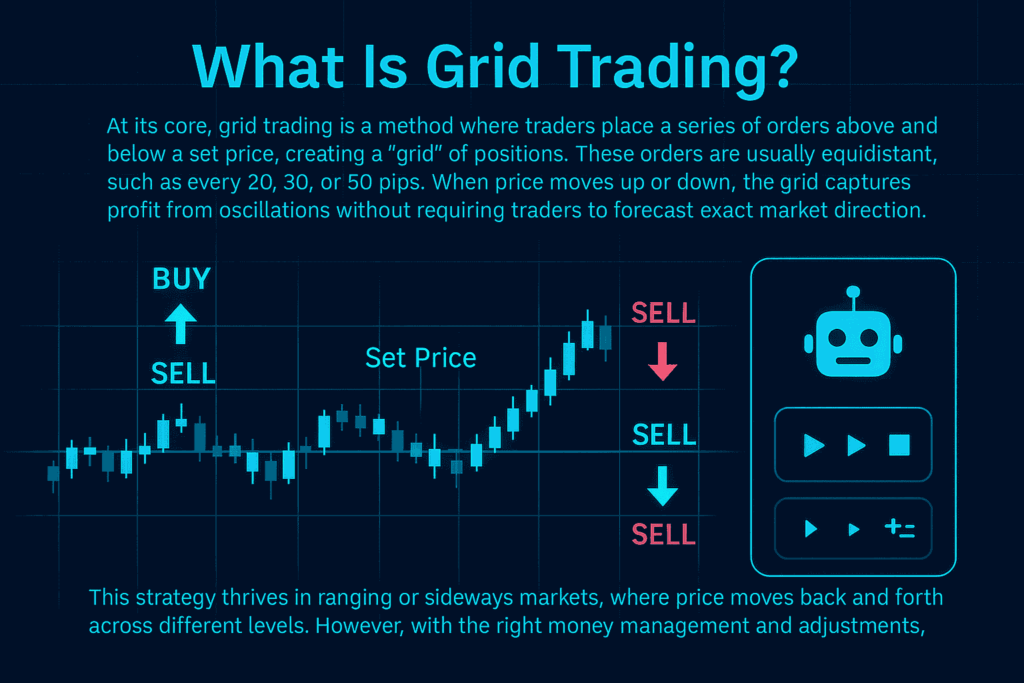
At its core, grid trading is a method where traders place a series of orders above and below a set price, creating a “grid” of positions. These orders are usually equidistant, such as every 20, 30, or 50 pips. When price moves up or down, the grid captures profit from oscillations without requiring traders to forecast exact market direction.
This strategy thrives in ranging or sideways markets, where price moves back and forth across different levels. However, with the right money management and adjustments, it can also be adapted for trending markets.
How Does It Work?
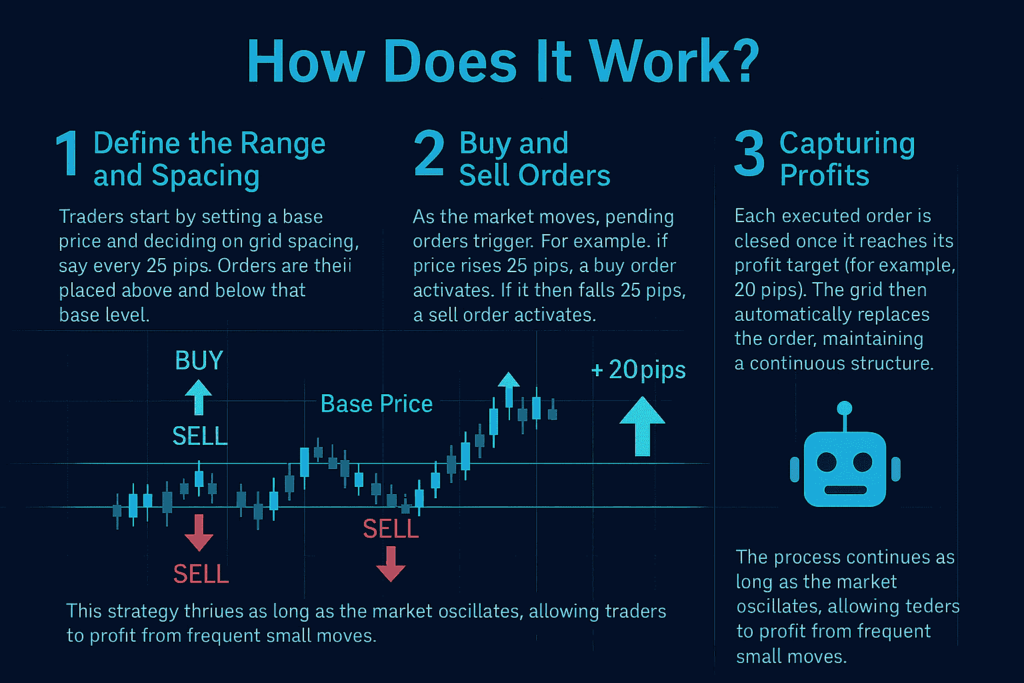
- Define the Range and Spacing
Traders start by setting a base price and deciding on grid spacing say every 25 pips. Orders are then placed above and below that base level. - Buy and Sell Orders
As the market moves, pending orders trigger. For example, if price rises 25 pips, a buy order activates. If it then falls 25 pips, a sell order activates. - Capturing Profits
Each executed order is closed once it reaches its profit target (for example, 20 pips). The grid then automatically replaces the order, maintaining a continuous structure. - Ongoing Execution
The process continues as long as the market oscillates, allowing traders to profit from frequent small moves.
Advantages of Grid Trading
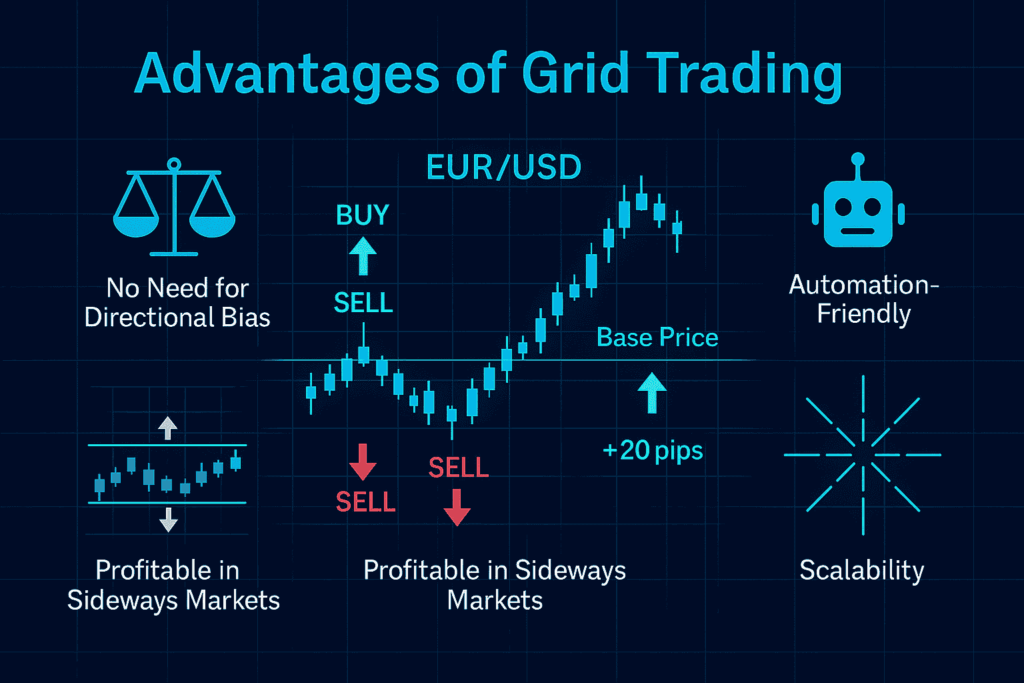
- No Need for Directional Bias
Traders don’t need to predict whether the market will rise or fall only that it will move. - Automation-Friendly
Grid strategies are easily automated, reducing emotional decision-making. - Profitable in Sideways Markets
While trends can hurt range-bound systems, grid trading often shines when markets move within predictable ranges. - Scalability
Traders can customize grid size, spacing, and lot sizes depending on account size and risk tolerance.
Risks and Challenges
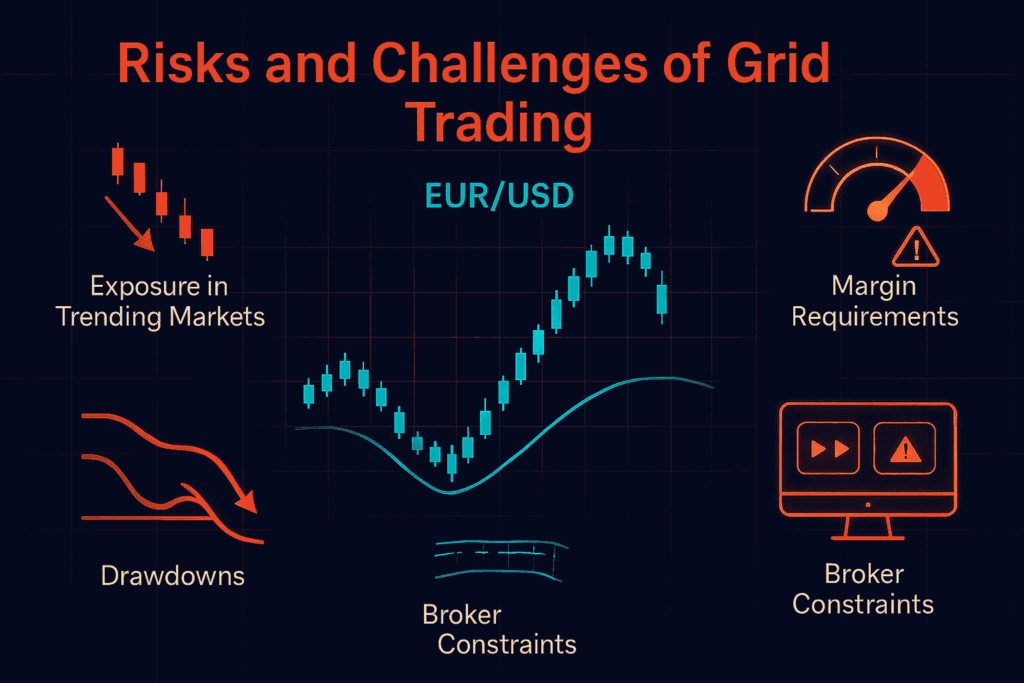
Despite its appeal, grid trading is not risk-free:
- Exposure in Trending Markets
If the market trends strongly in one direction without retracing, traders can accumulate losing positions. - Margin Requirements
Since multiple trades remain open simultaneously, margin can be strained during volatile periods. - Drawdowns
Large drawdowns are possible if risk parameters are not carefully set. - Broker Constraints
Some brokers may not be ideal for grid trading due to spreads, execution speed, or margin policies.
Best Practices for Grid Traders
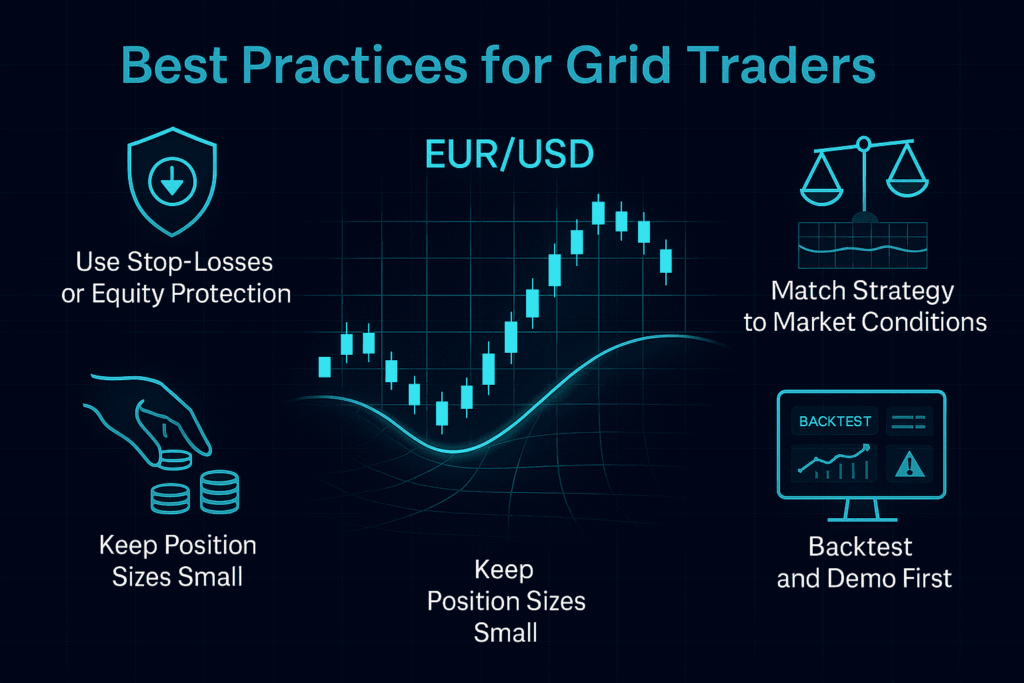
- Use Stop-Losses or Equity Protection
Even if grids are designed to “wait out” reversals, traders should define maximum drawdown thresholds. - Match Strategy to Market Conditions
Grid systems work best in ranging markets. Traders should avoid deploying them during high-impact news releases or one-way trending environments. - Keep Position Sizes Small
Since multiple trades may open at once, conservative lot sizing reduces the risk of margin calls. - Backtest and Demo First
Before using grid trading live, it’s essential to test strategies on historical data and practice in demo accounts.
Practical Example
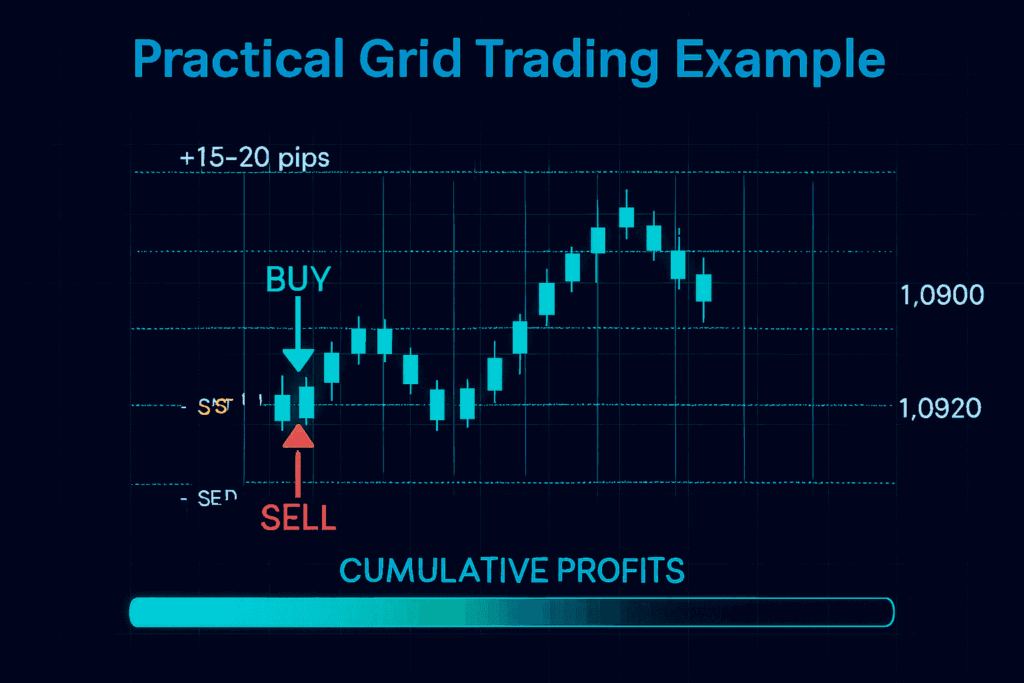
Imagine EUR/USD trading around 1.0900. A trader sets up a grid with buy and sell orders every 20 pips. If the pair rises to 1.0920, a buy order triggers. If it then drops to 1.0880, a sell order triggers. Both trades target 15–20 pips profit. As price oscillates between these levels, the system keeps harvesting small gains, building cumulative profits over time.
Final Thoughts
Grid trading offers a structured, rules-based method for capturing frequent small profits in forex markets. While it reduces the need to predict direction, it comes with risks especially in strongly trending conditions. Success with grid trading depends on disciplined risk management, careful position sizing, and choosing the right market environment.
For traders willing to plan and test their systems, grid trading can be a valuable tool in a broader forex strategy toolkit.